Monday, October 14, 2013

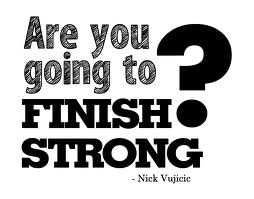
Finishing is tough but so rewarding...


Sometimes, when know that the end of a sprint or top of a hill is just 15 seconds away—so close that you can "see" it—I notice we do one of two things: “We” either slow down right away, coasting to the finish without much effort – OR – “We” buckle down and push on through the end with strength and heart. Which person are you?

When you lose a sale, do you give up for the rest of the week, or get back on track so that one slipup doesn't get in your way?

When life gets busy, do you skip your sales preparation entirely, or do you squeeze in whatever you can, even if it's only 10 or 15 minutes?

Finishing strong isn't that much different than any other challenge or goal in life. You have to decide that you want to do it, work hard even though resistance is working against you, and then follow through until you reach the top.

Two common phrases I reflect on during these times, "Give yourself a finish that you'll be proud of," and, "Finish just as strong as you started." And that's what I want to encourage you to do as you're facing the most difficult time today.

You will never regret choosing to work hard and climb to the top of that hill, no matter how challenging it may be or how much resistance is trying to hold you back. But you will regret giving up early, putting it off, and simply coasting to the finish line (which is a lot like backpedaling). In a race, a runner doesn't start to walk once the finish line is in sight ("Whew, I'm almost there, so I'll just relax now!"). That runner kicks it in and gives everything he or she has left until they cross that line.

So why should you treat your own goals any differently? Your personal finish line is no less important, and you owe it to yourself to get there without giving up. Use whatever effort you have left so that you, too, can finish out this quarter—that final hill—with a sprint to the finish. A finish you can be proud of.  A finish of victory!


Hail To Victory…here-here!

Friday, September 27, 2013

What Graciousness Means To Me

Graciousness reflects a state of being; it emanates from your inventory of self.

When wandering the world, forget your business cards. Don't look for more contacts. Instead, observe. Say hello to the people you see every day, but don't make a fetish out of it. Stay interested in others. Be generous in your attentions but not showy. Don't wink, snap your fingers, high-five, or shout, though laugh with those who do. It bears repeating: Look around. Remember names. Remember where people were born.

On the street, in the lobby, square your shoulders to people you meet. Make a handshake matter — eye contact, good grip, elbow erring toward a right angle. Do not pump the hand, unless the other person is insistent on just that. Then pump the hell out of their hand. Smile. If you can't smile, you can't be gracious. You aren't some dopey English butler. You are you.

Remember that the only representation of you, no matter what your station, is you — your presentation, your demeanor. You simply must attend. Stand when someone enters the room, especially if you are lowly and he is the boss, and even if the reverse is true. Look them in the eye. Ask yourself: Does anybody need an introduction? If so, before you say one word about business, introduce them to others with pleasure in your voice. If you can't muster enthusiasm for the people you happen upon in life, then you cannot be gracious. Remember, true graciousness demands that you have time for others.


So listen. Be attentive to what people say. Respond, without interruption. You always have time. You own the time in which you live. You grant it to others without obligation. That is the gift of being gracious. The return — the payback, if you will — is the reputation you will quickly earn, the curiosity of others, the sense that people want to be in the room with you. The gracious man does not dwell on himself, but you can be confident that your reputation precedes you in everything you do and lingers long after you are finished. People will mark you for it. You will see it in their eyes. People trust the gracious man to care. The return comes in kind.

Thursday, May 16, 2013

Hello...I am an INVE$TOR


I am an investor. I do not trade my assets frequently. That's speculation, not investing.

I am also a saver, fueling my investments with continuous savings from current income.

I know that every kind of asset entails risk -- even cash, which can be eroded by inflation.

I know that higher returns entail higher risk, in every kind of asset.

I accept those risks, but I mitigate them by owning a diversity of assets.

I regard my home as a place to live, not as an investment. It is not a substitute for retirement savings.

I have an investment plan and a plan for asset allocation, in consultation with a financial adviser.

I invest regular amounts every month, in both rising and falling markets. I know I can­not gauge market tops and bottoms. If I receive a windfall -- a bonus, bequest or gift -- I gradually feed it into my regular investment mix.

I don't pour more money into hot markets nor completely cash out of plunging markets.

I spread my investments among several asset classes, in a mix fitting my age and risk tolerance.

My share of bonds roughly equals my age. I will allocate to stocks a declining portion of my financial assets as I get older.

I rebalance my portfolio every quarter. If the stock market plunges, pushing my stock allocation way below its target percentage, I sell bonds and use my cash to buy stocks.

I force myself to sell high and buy low by periodic rebalancing -- just what is temperamentally difficult for most investors to do.

I know that stocks are risky in the short run, so I hold in equities no money for which I have a likely need in the next three years.

But stocks are not too risky in the long run. They have outperformed all other commonly traded assets over periods of 15 years and longer.

Foreign stocks account for at least 15% of my stock allocation. I believe that developing economies will enjoy much higher growth than the U.S. in the decades ahead.

I never borrow against my stocks. Margin calls could force me to sell good assets at a bad time.

I stick with my game plan. I do not check the value of my investments every day or even every week.

I try to keep my cool when other folks are losing theirs.

I remind myself often: I am an investor.

Tuesday, May 14, 2013

Leadership, what is it?


"A good leader is a good follower". To be able to lead people, one must first know how to be a good team member. A good leader supports his members and encourages them. He motivates them to strive for the best; makes them feel they are special people. A good leader does not belittle his members but enhances their talents.

Leadership has nothing to do with seniority or one’s position in the hierarchy of a company. Too many talk about a company’s leadership referring to the senior most executives in the organization. They are just that, senior executives. Leadership doesn't automatically happen when you reach a certain pay grade. Hopefully you find it there, but there are no guarantees.

Leadership has nothing to do with titles. Similar to the point above, just because you have a C-level title, doesn't automatically make you a “leader.” In all of my talks I stress the fact that you don’t need a title to lead. In fact, you can be a leader in your place of worship, your neighborhood, in your family, all without having a title.

Leadership has nothing to do with personal attributes. Say the word “leader” and most people thing of a domineering, take-charge charismatic individual. We often think of icons from history like General Patton or President Lincoln. But leadership isn't an adjective. We don’t need extroverted charismatic traits to practice leadership. And those with charisma don’t automatically lead.

Leadership isn't management.  This is the big one. Leadership and management are not synonymous.  You have 15 people under your hierarchy and P&L responsibility? Good for you, hopefully you are a good manager. Good management is needed. Managers need to plan, measure, monitor, coordinate, solve, hire, fire, and so many other things. Typically, managers manage things. Leaders lead people.

Traits of Effective Leaders

...Make others feel important. If your goals and decisions are self-centered, followers will lose their enthusiasm quickly. Emphasize their strengths and contributions, not your own.

...Promote a vision. Followers need a clear idea of where you're leading them, and they need to understand why that goal is valuable to them. Your job as a leader is to provide that vision.

...Follow the golden rule. Treat your followers the way you enjoy being treated. An abusive leader attracts few loyal followers.

...Admit mistakes. If people suspect that you're covering up your own errors, they'll hide their mistakes, too, and you'll lack valuable information for making decisions.

...Criticize others only in private. Public praise encourages others to excel, but public criticism only embarrasses and alienates everyone

...Stay close to the action. You need to be visible to the members of your organization. Talk to people, visit other offices and work sites, ask questions, and observe how business is being handled. Often you will gain new insights into your work and find new opportunities for motivating your followers.

...Make a game of competition. The competitive drive can be a valuable tool if you use it correctly. Set team goals, and reward members who meet or exceed them. Examine your failures, and celebrate your group's success.

SOME QUOTES ON LEADERSHIP...

My grandfather once told me that there were two kinds of people: those who do the work and those who take the credit. He told me to try to be in the first group. There is much less competition. Indira Gandhi

One of the tests of leadership is the ability to recognize a problem before it becomes an emergency. Arnold Glasgow

Effective leadership is putting first things first. Effective management is discipline, carrying it out. Stephen Covey

A real leader faces the music, even when he doesn't like the tune. Unknown Author

A big man is one who makes us feel bigger when we are with him. John C. Maxwell

Wednesday, March 20, 2013

Finish Strong! How to end a quarter....


It's Spring, a time when most of us feel a sense of renewed energy, hope and optimism. But, this year, Spring brings with it mixed emotions  and concern about the days ahead. Why because we are tasked daily with “change.” We pause with concern and after a moment we think, “I’m okay; I still have time to make changes” and we go about the rest of our day.  But…how do you finish?

Finishing strong helps you leave well. You will only get one chance to finish well in this position then history will decide how you are remembered. When you keep your eye on the finish line, you stay focused on doing your best right up until the end. Success isn’t about starting but finishing. The end of the quarter brings some questions with it:

“Was it worth it?”
“Did I really make a difference?”
“What kind of effort can I honestly put into this thing in the last few days?”
These types of questions can conjure up feelings of regret over what you expected to happen and where you’re currently at. They can also motivate you to make the most of the moments you have left to serve.

It all depends on where your focus is: regret or resolve.

The difficulty with regret is that it comes with the realization that you can’t go back and change what has already happened. The beauty of resolve is that it doesn’t matter what’s happened in the past, you can keep your eyes focused on where you’re headed in the present. You can experience a breakthrough in your leadership when you’re able to focus and concentrate on those areas where you can lend your strengths. 
When you finish strong, it serves as a model for yourself, your team, your division, your company. This isn't just about you, but about all of the people whom you lead. A successful ending should be a team effort. Work to keep yourself engaged, motivated, and connected to the goals and vision of the team right up to the end. Nothing will deflate team morale more than to have members of a team slowly fade away before the quarter is up.  Sales is a team sport!

The difference between a leader and a follower is found in the willingness one has to accept responsibility. You may have some “good reasons” for shirking your responsibilities as it gets close to the end. But you only miss out on the sense of satisfaction and personal pride of seeing your responsibility through to the end.

If you've read all the way to this point, you probably realize that finishing strong is a principle that you need to follow in everything you do. Do the hard work on the back end to see your commitments through.
The best piece of advice you can take from all that I have said: “Don’t give up…finish strong!

Wednesday, March 13, 2013

Art of "Sales" Change Part 2


Yesterday we looked at the first 5 strategies of the change transformation...have you made any changes yet? If not, here are the last 5 strategies of the change transformation:

  1. Forget about the “future,” focus on your today: The “future” is an abstraction. It doesn't exist except as an idea. The only future that has any reality is the one that you continually create for yourself through each day’s contributions, achievements, and results. This is an excellent time to ignore all those experts who never saw the present circumstances coming. Focus on what you can do over the course of each 24 hours, and you’ll be the only expert on the future you’ll ever need.
  2. Forget about who you were, focus on who you can be: Many people define themselves by external circumstances. When these abruptly change, they don’t know who they are, so they keep trying to be who they used to be. From now on, take your cues from the inside — from your dreams, ideals, values, and operating principles. These need never change, regardless of the circumstances.Take advantage of the present external confusion to become self-directed, self-managed, and self-motivated.
  3. Forget about events, focus on your responses: When things are going well, many people think they are actually in control of events. That’s why they feel so defeated and depressed when things turn bad. They think they've lost some fundamental ability. The most consistently successful people in the world know they can’t control events — but continually work towards greater control over their creative responses to events. This period, while things are uncertain, is an excellent time to focus all of your attention and energies on being creatively responsive to all of the unpredictable events that lie ahead.
  4. Forget about what’s missing, focus on what’s available: When things change for the worse, many desirable resources are missing — including information, knowledge, tools, systems, personnel, and capabilities. These deficiencies can paralyze many people, who believe they can’t make decisions and take action. A strategic response is to take advantage of every resource that is immediately available to achieve as many small results, to make as much daily progress, as possible. Work with every resource and opportunity at hand, and your confidence will continually grow.
  5. Forget about your complaints, focus on your gratitude: This is one of those times when everyone has to make a fundamental decision: to complain or to be grateful. When things turn negative, the consequences of this decision are much greater. Complaining only attracts negative thoughts and people; gratitude creates the opportunity for the best thinking, actions, and results to emerge. Focus on everything that you are grateful for — communicate this —and open yourself each day to the best possible consequences.

Tuesday, March 12, 2013

Art of "Sales" Change Part 1


As Jim Rohn once said…any day we wish, we can discipline ourselves to change it all. Any day we wish, we can open the book that will open our mind to new knowledge. Any day we wish, we can start a new activity. Any day we wish, we can start the process of life change. We can do it immediately, or next week, or next month, or next year.  But why wait?
We can also do nothing. We can pretend rather than perform. And if the idea of having to change ourselves makes us uncomfortable, we can remain as we are. We can choose rest over labor, entertainment over education, delusion over truth, and doubt over confidence. The choices are ours to make. But while we curse the effect, we continue to nourish the cause. As Shakespeare uniquely observed, “The fault is not in the stars, but in ourselves.” We created our circumstances by our past choices. We have both the ability and the responsibility to make better choices beginning today. Those who are in search of the good life do not need more answers or more time to think things over to reach better conclusions. They need the truth. They need the whole truth. And they need nothing but the truth.
We cannot allow our errors in judgment, repeated every day, to lead us down the wrong path. We must keep coming back to those basics that make the biggest difference in how our life works out. And then we must make the very choices that will bring life, happiness and joy into our daily lives.
And if I may be so bold to offer my last piece of advice for someone seeking and needing to make changes in their life: If you don’t like how things are, change it! You’re not a tree. You have the ability to totally transform every area in your life. And it all begins with your very own power of choice.
Now, how do we change?  Below are the first 5 strategies of the change transformation:
  1. Forget about yourself, focus on others: Fear can drive people into themselves, making them feel isolated and helpless. The best strategy here is to go in the opposite direction, expanding your connection with others — focusing on helping them transform their negatives into positives. The more you contribute in this fashion, the less you will need to worry about your own situation. You will become a source of confidence for everyone else.
  2. Forget about your commodity, focus on relationships: In scary times, people become frightened about the viability of their “commodities” — the things they sell and the jobs they hold. A more strategic response here is to disregard your own commodity and focus on deepening the power and possibility of all your relationships —with family, friends, team members, suppliers, clients, customers, and prospects. Every time you strengthen a relationship, the viability of your commodity, without you focusing on it, will increase.
  3. Forget about the sale, focus on creating value: Most people don’t like being sold at the best of times. When times are scary, they turn off, hang up and slam shut. But what people want at all times is value creation — that is, solutions that help them eliminate their dangers, capture their opportunities, and reinforce their strengths. When you focus on providing these three solutions, the sales will naturally follow.
  4. Forget about your losses, focus on your opportunities: Things you had, things you took for granted, may have disappeared. Some people never get over this. They keep trying to replay their old games. A better strategy is to start an entirely new game — using new ideas, new energies, new tools, and new resources. A big opportunity is suddenly available now for achieving far more than you ever did in the past.
  5. Forget about your difficulties, focus on your progress: Things may not be as easy as they were. The new difficulties will either defeat you or reveal new strengths. Your physical muscles always get stronger from working against resistance. The same is true for the muscles in your mind, your spirit, and your character. Treat this whole period of challenge as a time when you can make your greatest progress as a human being.